Choosing among the many types of custom patches on the market can feel overwhelming when you are ordering for a uniform program, a sports club, a motorcycle association, or a corporate merchandise run. Texture, durability, budget, and the fabric the patch will sit on all play a role in the right decision.
This guide walks through every patch style available for custom patches CA orders and compares the most commonly confused pairings, such as PVC vs embroidered patches, woven vs embroidered patches and embroidered vs printed patches, and covers backing options, border finishes, materials, and sizing so you can order with confidence.
Why the Patch Type You Choose Matters
Not every patch style suits every application. A custom patch destined for a leather motorcycle vest behaves differently than one meant for a nylon backpack or a cotton twill baseball cap.
Before comparing individual styles, it helps to understand the three factors that should drive your decision: the level of detail in your artwork, the environment the patch will face (indoor apparel versus outdoor tactical gear), and your budget across the order quantity.
With those three factors in mind, the following breakdown of custom patch types, patch backings, patch borders, and patch materials will help you land on the right combination.
The Main Types of Custom Patches
Embroidered Patches
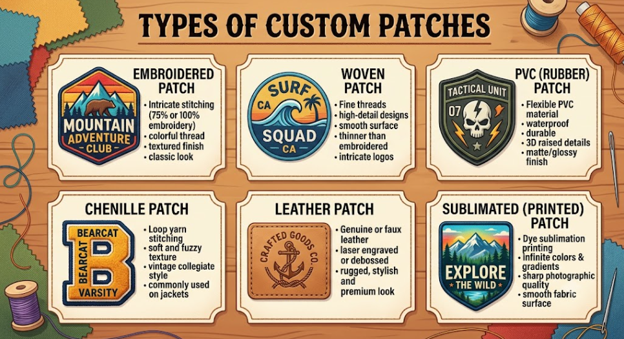
Custom embroidered patches remain the most requested option across the patch industry and are often the default recommendation for logos, uniform badges, club emblems, and awards. Thread is stitched onto a twill backing using computerized embroidery machines, producing a raised, textured surface with visible stitch direction.
Embroidery coverage typically ranges from fifty to one hundred percent, with higher coverage adding richness and cost. Embroidered patches suit bold logos, thick line work, and traditional badge designs, though very small text under roughly four millimetres can lose clarity because of thread thickness.
Woven Patches
Custom woven patches use a much finer thread on a tighter weave than embroidered patches, which produces a flatter, smoother surface capable of reproducing small text, gradients, and intricate line work.
Anyone comparing woven vs embroidered patches should note that woven patches hold detail down to roughly two millimetres, while embroidered patches struggle below four millimetres. Woven patches suit designs with fine typography, photorealistic elements, or dense artwork where a raised, textured surface is not the goal.
PVC Patches
Custom PVC patches are moulded from soft, flexible plastic rather than thread or fabric. They are fully waterproof, resistant to scratching and fading, and hold up well outdoors, which makes them a favourite for tactical gear, outdoor apparel, backpacks, and military or first-responder programs.
Because of the moulding process, PVC patches cannot take an iron-on backing, since the heat required would damage the plastic, though sew-on and Velcro backings both work well.
When teams weigh PVC vs embroidered patches, the deciding factors usually come down to environment and finish: PVC wins for durability and weather resistance, while embroidered wins for a traditional, textured, fabric-based look.
Chenille Patches
Custom chenille patches have a soft, fuzzy, raised texture created from a looped yarn construction, giving them the plush look associated with varsity and letterman jackets. They add dimension and a retro feel and are popular for school lettering, achievement patches, and fashion-forward branding.
Printed (Sublimated) Patches
Custom printed patches, also called sublimated patches, use dye transferred directly into a polyester fabric rather than into thread. This method reproduces unlimited colours, gradients, and photographic detail that embroidery cannot achieve, and the finished patch is smooth and lightweight rather than textured.
In the embroidered vs printed patches comparison, printed patches win on colour complexity and fine photographic detail, while embroidered patches win on tactile texture, perceived durability, and the classic look buyers associate with badges and uniforms.
Printed patches can fade slightly faster than embroidered or PVC options under frequent washing, so they suit lower-wash applications such as promotional giveaways or event merchandise.
Leather Patches
Custom leather patches, whether genuine or faux leather, give a premium, debossed, or engraved finish popular on caps, bags, and outdoor brand merchandise. They age with character, hold stitching well, and add a rugged, upscale feel that fabric-based patches cannot replicate.
3D Puff Embroidered Patches
Custom 3D puff embroidery patches use a foam underlay beneath the embroidery to raise the design above the fabric surface, adding a bold, sculptural effect that works especially well for lettering-heavy logos on caps and jackets.
If you want to dig deeper, then hop onto our blog on 3D embroidery vs. regular embroidered patches for further details.
Sequin Patches
Custom sequin patches use layered, reversible sequins that can be brushed in two directions to reveal different colours, a novelty effect popular in fashion and youth apparel rather than corporate or uniform programs.
PVC vs Embroidered Patches
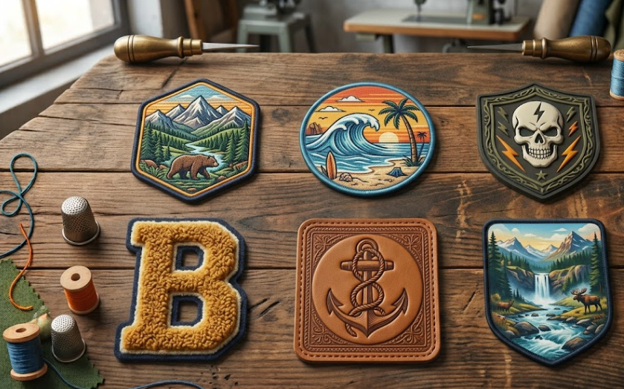
PVC vs embroidered patches is one of the most common questions buyers ask. PVC patches are waterproof, durable, and vibrant, ideal for bags and tactical gear. Embroidered patches are fabric-based, classic, and suited for uniforms or jackets. PVC patches usually cost more but are justified for outdoor durability.
Woven vs Embroidered Patches
When choosing between woven vs embroidered patches, opt for woven for detailed artwork. They capture small text and fine outlines better, while embroidery lacks precision.
Embroidered vs Printed Patches
The choice between embroidered vs printed patches depends on colour complexity and wash frequency. Printed patches allow colour gradients, while embroidered ones offer durability and texture for long-term use.
Patch Backing Types Explained
The backing determines how a patch attaches to fabric, and getting it right matters as much as the patch type itself.
- Sew-on (plain) backing leaves the stitching exposed on the reverse side and is sewn directly onto a garment. It is the most permanent and durable option, ideal for uniforms and workwear that go through frequent washing.
- Iron-on backing applies a heat-activated adhesive layer that bonds with a household iron or heat press. It is fast and convenient for casual wear, jackets, and kids’ clothing, though it does not perform well on nylon, waterproof shells, or leather, and it is not compatible with PVC patches.
- Velcro (hook-and-loop) backing lets a patch be attached and removed repeatedly, which is why it dominates military, tactical, security, and sports team programs where patches rotate between garments.
- Adhesive (self-adhesive) backing works like a peel-and-stick label and suits short-term or one-time applications such as events, costumes, or product samples rather than long-term wear.
- Button loop backing is a smaller-scale option, most associated with scouting and achievement patches that attach through a loop rather than stitching.
Patch Border and Edge Options
Border style affects both appearance and how well a patch resists fraying over time.
- Merrowed border wraps thread continuously around the patch edge, producing the thick, raised, classic look most people associate with badges. It suits standard shapes such as circles, ovals, rectangles, and squares and pairs naturally with sew-on or Velcro backing.
- Laser cut (hot cut) border uses heat to seal the fabric edge without a stitched wrap, allowing tight, custom shapes and fine detail near the border. It is the standard choice for irregular shapes and pairs well with iron-on backing, since the seal extends cleanly to the edge. Compare laser/hot-cut borders with merrowed borders for further analysis.
- No border (raw edge) is occasionally used on printed or PVC patches where the material itself is sealed during production and an added border is not required.
Choosing the Best Patch Material for Your Fabric
The garment or gear a patch will sit on should guide the material choice as much as the design itself.
| Target Fabric | Recommended Patch Type | Why |
| Cotton twill caps and jackets | Embroidered or 3D puff | Classic texture bonds well with woven fabric |
| Denim | Embroidered or leather | Holds stitching securely, ages well together |
| Nylon and technical outerwear | PVC or woven | Iron-on adhesion is unreliable on synthetic shells |
| Leather jackets and vests | Leather or embroidered with sew-on backing | Sew-ons avoid heat damage to leather |
| Backpacks and tactical gear | PVC with Velcro backing | Waterproof and swappable |
| Varsity and letterman jackets | Chenille | Traditional plush texture expected on wool body |
| Polyester sportswear | Printed (sublimated) | Matches synthetic base and reproduces team colours accurately |
Patch Sizes and Other Specifications
Custom patches range from five to fifteen centimetres, with common shapes like circles and rectangles. Canadian patch suppliers, including The Custom Patches Canada, offer thread and Pantone matching, low minimum orders, and quick mockup turnaround, while production times vary by patch type.
Frequently Asked Questions
What is the most durable type of custom patch?
PVC patches are the most durable, waterproof, and scratch-resistant. Embroidered patches are second for uniforms, while PVC is best for heavy-use gear like backpacks and tactical vests.
What type of custom patch is best for small, detailed logos?
Woven patches excel for small, detailed logos; sublimated patches suit complex images with shading. Embroidered patches work best for bold, simple logos needing texture over fine detail.
Which patch backing is best for uniforms that get washed often?
Sew-on backing is the most durable for frequent washing. Velcro is ideal for removable patches, while iron-on backing suits lighter-use apparel due to heat-seal adhesive weakness.
Can I combine patch types, such as embroidered details with a PVC base?
Hybrid patches merge embroidered details with a PVC base for tactical and sports uses, balancing fine design with durability, but cost more due to dual production processes. Always verify supplier capabilities.
Ready to bring your design to life?
For businesses, sports clubs, schools, and organizations across Canada, working with a domestic custom patches CA supplier means faster turnaround, no cross-border customs delays, and pricing quoted in Canadian dollars. The Custom Patches Canada produces all types of custom patches. Contact us to order your patches today!