
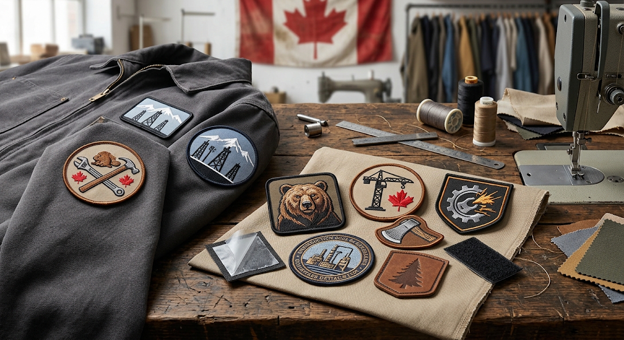
A patch on a work jacket is supposed to get washed every week while it faces friction, sweat and a harsh environment, living a harder life than one on a hoodie.
When you search for custom patches for workwear Canada, many options will pop up, that can become the reason, where your confusion may sprout from. Like different materials, backings and sizes
This guide covers the three basic choices that matter, which are material, backing and size.
What Makes Custom Patches for Workwear in Canada Different?
Workwear patches are used more than fashion patches, which is why they need washing maybe once or twice in a week, get rough contact, and some even have safety rules.
Because a workwear patch has a company name or role, which is why it has to stay readable from a distance.
Where Workwear Patches Go On Workwear
Work uniform patches are used to make company and employee identification easier.
| Garment | Common Patch Placement | Purpose |
| Work shirts | Left chest | Displays the company logo or employee name |
| Jackets | Chest, sleeve, or back | Makes company branding easy to see |
| Coveralls | Chest or upper sleeve | Identifies the company and worker |
| Aprons | Upper chest | Displays the business name or logo |
| Toques (knitted winter hats) | Front or folded cuff | Adds company branding to winter workwear |
| High-visibility vests | Chest or back, where permitted | Identifies workers while maintaining visibility |
| Delivery uniforms | Chest or sleeve | Helps customers recognize company staff |
| Warehouse uniforms | Chest or upper sleeve | Makes team and company identification easier |
Different work patches
Logo Patches
Logo patches for workwear display the company’s name, logo, or brand symbol so the customers and co-workers can identify the business even from afar.
Name Patches
To display an employee’s name on their uniform, name patches are used, making it easier for customers and team members to recognize them.
Role Patches
Role patches show what job title or responsibility an employee holds, such as Supervisor, First Aid, or Security, helping others know who they are quickly.
Which Patch Material Suits Workwear?
The following are the material choices for patches that cause confusion among people, but after going through this section, your confusion will subside.
Embroidered patches
How They Are Made
Embroidered workwear patches are made from a fabric base on which the design gets stitched with threads. The raised stitching gives a logo a clear shape, and the thread copes well with washing.
What They Offer
- Givess a slight 3D look and raised texture.
- Withstands regular washing.
- Provides a professional look for workwear.
- Best results with bold designs and clear lettering.
Look Out For
Small text and thin designs can get mixed up in stitches.
Woven patches
How They Are Made
Woven patches are weaved into a fabric on a loom without using any base. The threads it uses are finer than embroidery ones.
What They Offer
- Carry small text and thin designs.
- Give a smooth surface.
- Are lightweight on uniforms.
Look Out For
Do not have any textured or 3D look.
Leather patches
How They Are Made
As the name states, they are made of leather, the designs can be either printed, embossed or engraved on real or faux leather, at your call.
What They Offer
- Give a premium and rugged look.
- Provide a stylish branding option.
- Make everything look luxurious.
Look Out For
They can get worn rather easily through the wash and dryer. They provide less colour options.
PVC patches
How They Are Made
PVC is a rubber material from which the patches are made by melting it and setting it into a mould until it cools down and hardens.
What They Offer
- Are flexible and rubber like.
- They are waterproof.
- More durable and suitable for outdoor wear.
Look Out For
PVC patches are heavy and may not produce the gradient designs or small text well.
Materials In Brief
| Material | What it looks like | Suits | Watch out for |
| Embroidered | Raised, stitched thread | Jackets, polos, vests, coveralls | Tiny text can blur |
| Woven | Flat, fine detail | Small text and detailed logos | Less texture |
| Leather | Smooth and rugged | Supervisor jackets, caps, merchandise | Wears faster with soaking and heavy washing |
| PVC | Moulded, rubber-like | Rain gear, outdoor and wet work | Feels firm on thin fabric |
Which Backing Works for Work Uniforms?
You will see choices in backings as well other than the material, each lets you attach the patch differently.
Sew-on backing
Sew-on patches are held on by thread, they come with no additional layer on the rare. You can either sew them or use fabric glue to paste the patch.
How It Works
- Mark the place where you want to put it.
- Pin it so it does not move.
- Thread the needle with a matching thread to your patch border.
- Stitch the edges carefully with even stitches.
- Tie a knot when you stitch around the whole border
Iron-on (heat seal) backing
Iron-on patches come with a glue layer on the back, which melts when it comes into contact with heat.
How It Works
- Check the fabric if it is heat sensitive or not.
- Then mark the area where you want to attach the patch.
- Cover it with a cotton cloth.
- Heat the iron on a medium to low setting.
- Iron the patches for 15 to 20 seconds without sliding the iron.
- Then check for the lifting edges.
- If there are any, then press the patch again for a few seconds.
Hook-and-loop backing
Hook and loop backing is called Velcro, it comes with two strips, one is the hook side, which grips onto the other side, which has loops on it.
How It Works
- Position the loop panel where you want to put the patch.
- You have to glue or sew the loop side to the garment first.
- Press the hook side firmly against the loop side.
- You can pull the patch away when you want to swap it.
Peel-and-stick backing
Peel and stick backing comes with an adhesive layer on the back of the patch.
How It Works
- Clean the surface, make sure there is no lint or dust.
- Peel the sticker cover layer at the back of the patch.
- Press the patch and stick it firmly.
Key Takeaways for Patch Backings
| Backing | How it attaches | Suits | Watch out for |
| Sew-on | Thread | Jackets, coveralls, laundered uniforms | Needs sewing and leaves needle holes when removed |
| Iron-on (heat seal) | Heat-activated glue | Cotton shirts and lighter use | Heat can damage nylon, and the hold is weaker than stitching |
| Hook-and-loop | Hook side on the patch, loop side on the garment | Swappable name and role patches | Lint and snagging |
| Peel-and-stick | Sticky adhesive | One-off events | Not for washing or daily wear |
Which Border Stops Patches Fraying?
You also have options for borders, each gives a different look.
Merrowed Border
The border is stitched with thick, bold and closed stitches and sits around the patch cleanly, which gives the patch a refined look. This border works for simple and basic shapes like circles or squares.
Laser-Cut Border
The border is cut using a laser, which is suitable for intricate outlines, sharp corners, and detailed designs that need a clean finish.
Raw Edge
A patch with no added border can be made also, it works with any shape, but the edges can fray over time.
Which Border Should You Choose?
| Border Type | When to Choose It |
| Merrowed | For durable, thick edges on standard shapes. |
| Laser-Cut | For detailed or irregular shapes. |
| Raw Edge | For an unfinished, casual look. |
What Size Should Workwear Patches Be?
Size matters because you can not place a big patch to somewhere a small patch is supposed to go. Following are the common patch sizes that you can take a reference from.
| Placement | Common width | In centimetres | Good for |
| Left chest | 3 to 4 in | 7.5 to 10 cm | Company logo or name |
| Sleeve | 2 to 3 in | 5 to 7.5 cm | Role, crew or site |
| Back | 10 to 12 in | 25 to 30 cm | Large logo on jackets and vests |
| Cap front | Up to 2.5 in tall | About 6 cm | Simple logo with little text |
What Rules Apply to Hi-Vis and Flame-Resistant Garments?
There are some rules required for some uniforms, which you can see in this section.
High-visibility vests and jackets
- Approved standard: Follow CSA Z96 requirements for high-visibility safety apparel in Canada.
- Colours: Use approved fluorescent or bright background colours.
- Reflective stripes: Stripe width, placement, and coverage must meet the applicable standard.
- Visibility class: Choose Class 1, 2, or 3 based on workplace hazards and required visibility.
- Proper fit: Clothing should fit correctly, and reflective areas must not be covered.
- Maintenance: Keep garments clean and replace damaged or heavily worn items.
Flame-resistant garments
- Hazard assessment: Identify workplace fire and heat risks.
- Safety standards: Follow applicable standards, including NFPA 2112 for industrial flash-fire protection.
- Canadian standard: CAN/CGSB 155.20 is a recognized standard, but the 2017 edition was withdrawn in December 2022. Check the current requirements for your province and industry.
- Proper coverage: Protect exposed skin as required by the workplace hazard.
- Suitable materials: Use garments designed for the specific fire or heat risk.
- Inspection and care: Check for damage and follow the manufacturer’s washing instructions.
- Repairs and patches: Ensure alterations do not compromise protective performance.
- Electrical hazards: CSA Z462 covers workplace electrical safety, including arc-flash hazards.
How Do You Care for Patched Workwear?
- Keep the garment in a dry place.
- Do not leave it under direct sunlight.
- Do not fold the garment over the patch.
Washing patched workwear
- Turn the garment inside out.
- Wash at the temperature on the garment label and skip bleach.
- Wash it in a cold cycle.
- Dry on low heat or hang it up.
- High heat from the dryer can damage the patch.
Frequently Asked Questions
Can I order just a few workwear patches?
Yes, we have no minimum order, so you can start with a handful of patches to test them.
How long does it take to get custom workwear patches?
Turnaround time is 7 to 10 days for standard orders. We also provide rush delivery if you want your patches fast.
What if I only have a rough or low-quality logo?
That is fine because we offer free vector and design services.
Will taking off a patch damage my work jacket?
Sew-on patches can leave holes in the fabric, and iron-on patches can leave sticky residue that can be cleaned. They do not entirely damage the fabric.
Can I put patches on a waterproof jacket?
Yes, you can attach patches to any apparel as long as they are sew-on, but if your patch is iron-on, you have to look out for heat-sensitive fabrics.
How much do custom patches for workwear cost in Canada?
The price depends on the size, the material, the backing and order size. You need to get a free quote to know the actual price.
Get Your Uniform Patches Right in Canada
When you order custom patches for uniforms in Canada, it can become tricky, as you get to see all the option availablein material, backing and borders and also the most important part is that you consider is, some uni forms like hi-vis and flame resistant uniforms, follow some standard rules. All these things we have discussed above are worth a read if you are looking for uniform patches.
Send us your logo and tell us which garment it’s for, and we’ll prepare a free design and mockup. With no minimum order and a 7 to 10 day turnaround, a small test run is easy to set up.