
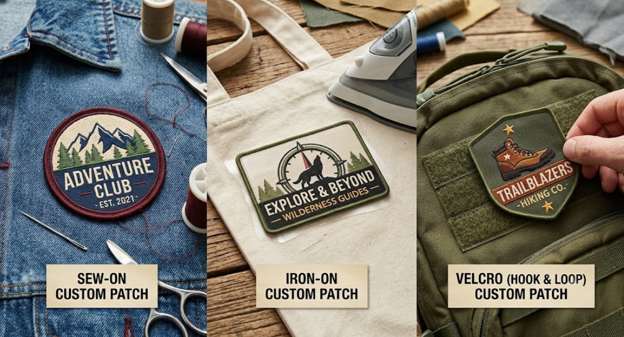
Choosing between iron-on vs. sew-on vs. Velcro backing is one of the first decisions every Canadian business, club, or organization faces when ordering custom patches, and it is a decision that shapes how long a patch lasts, how it looks, and how much flexibility a wearer has over time.
Whether the custom patches are destined for a hockey jersey in Calgary, a workwear jacket in Mississauga, or a motorcycle vest in Halifax, the backing method determines whether the patch becomes a permanent part of the garment or a removable badge that can move from one uniform to the next.
At The Custom Patches Canada, we produce all three backing types for clients across every province, and this guide is built to help you compare iron-on vs. sew-on patches and Velcro patch backing side by side so you can order with confidence the first time.
What Backing Options Actually Mean for Your Patches
Before comparing the three methods directly, it helps to understand what each backing type physically does to a patch. Backing is the layer applied to the reverse side of an embroidered or woven patch that determines how it attaches to fabric.
This is separate from the patch face itself, meaning any design, whether custom embroidered patches, custom woven patches, custom PVC patches, or custom chenille patches, can typically be finished with any of the three backing types depending on the material and intended use.
Iron-On Backing (Heat Seal Adhesive)
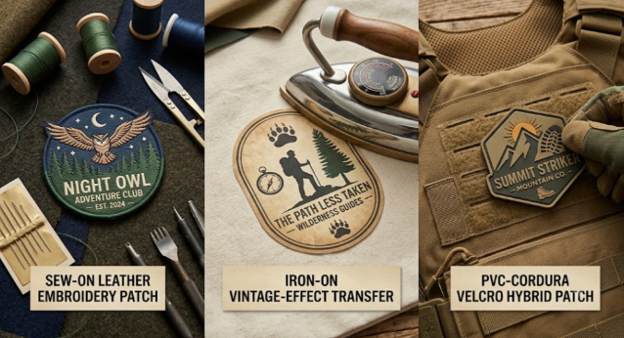
Iron-on patch backing uses a heat-activated adhesive film applied to the back of the patch during manufacturing. When exposed to heat from a household iron, heat press, or industrial press, the adhesive melts and bonds the patch directly to the fabric beneath it. This creates a smooth, low-profile finish that sits flush against the garment.
Sew-On Backing
Sew-on patch backing refers to a patch finished with a merrowed or hot-cut border designed specifically for stitching. The patch is attached using needle and thread, either by hand or with a sewing machine, creating a permanent mechanical bond between the patch and the fabric.
Velcro Patch Backing (Hook and Loop)
Velcro patch backing consists of two components: a hook strip sewn onto the back of the patch and a matching loop strip sewn onto the garment. The two pieces press together to hold the patch in place and can be separated and reattached repeatedly without damaging either the patch or the fabric.
Iron-On Backing: Strengths and Limitations
Where Iron-On Excels
Iron-on backing is the fastest and most cost-effective way to apply a patch to fabric, which makes it a popular choice for retail apparel, promotional merchandise, event giveaways, and one-time-use uniforms.
Because no sewing skill or equipment is required, iron-on patches can be applied at home, in a retail back office, or on a production line using a heat press in a matter of seconds per patch.
For Canadian businesses producing branded merchandise in bulk, such as caps, hoodies, and jackets sold across multiple provinces, iron-on backing significantly reduces labour costs compared with hand or machine sewing.
Iron-on backing also produces a clean, low-profile finish, since the adhesive lies flat against the fabric without adding bulk or stitching lines around the border.
Where Iron-On Falls Short
The primary limitation of iron-on backing is durability under stress. The adhesive bond can weaken over repeated washing cycles, particularly on fabrics that stretch, flex, or are exposed to high heat in dryers.
Custom iron-on patches are also not recommended for technical or performance fabrics such as Gore-Tex, ripstop nylon, or treated waterproof shells, since these materials are not designed to hold heat-activated adhesive and can be damaged by the temperatures required to bond the patch.
For garments that see heavy daily wear, such as work uniforms, motorcycle jackets, or outdoor gear, iron-on backing alone is generally not the most durable option, and many Canadian workwear suppliers recommend reinforcing an iron-on patch with a line of stitching around the border for long-term security.
Best suited for: promotional apparel, retail merchandise, light-use clothing, cotton and polyester blends, and one-time event uniforms.
Sew-On Backing: Strengths and Limitations
Where Sew-On Excels
Sew-on backing is widely regarded as the most durable and permanent attachment method available for custom patches in the Canadian market. Because the patch is mechanically stitched to the fabric, it withstands repeated washing, heavy movement, and extreme weather conditions far better than adhesive-based alternatives.
This makes sew-on backing the standard choice for law enforcement, military, fire and rescue services, and skilled trades across Canada, where patches must remain securely attached through years of daily use, industrial laundering, and physical activity.
Sew-on backing also works reliably on technical and heavyweight fabrics, including denim, leather, canvas, and performance outerwear, where iron-on adhesive would either fail to bond properly or damage the material.
Because the patch is permanently fixed, sew-on backing is also the preferred method for garments where a professional, tailored appearance matters, such as varsity jackets, blazers, and formal uniforms.
Where Sew-On Falls Short
The main trade-off with sew-on backing is labour and time. Attaching a patch by hand can take several minutes per patch, and while machine sewing speeds up the process for bulk orders, it still requires equipment and skilled operators that add to production cost and turnaround time.
Custom sew-on patches are also permanent, meaning they cannot be moved from one garment to another without unpicking the stitching, which is a consideration for organizations that rotate patches between uniforms, such as rank insignia or seasonal team badges.
Best suited for: uniforms, workwear, outerwear, denim and leather goods, law enforcement and military applications, and formal wear.
Velcro Patch Backing: Strengths and Limitations
Where Velcro Excels
Velcro patch backing offers a level of flexibility that neither iron-on nor sew-on can match, since patches can be attached, removed, and swapped without any tools, heat, or thread.
This makes it the preferred option for tactical gear; law enforcement and military applications where patches must be changed for different assignments; hunting and outdoor apparel; motorcycle gear; and youth sports uniforms where names, numbers, or sponsor patches change from season to season.
Velcro backing is also a strong choice for organizations that want employees or members to be able to move a single patch between multiple garments, such as a jacket, backpack, and cap, without purchasing duplicate patches for each item.
Because the hook and loop components are sewn on rather than glued, Velcro backing is also relatively durable for the garment side of the attachment, provided the loop panel is properly stitched during garment manufacturing or by a professional tailor.
Where Velcro Falls Short
Velcro backing requires a compatible loop panel to already exist on the garment, or one must be added separately, which increases upfront cost and complexity compared with iron-on or sew-on alone.
Over time and repeated use, hook and loop fasteners can accumulate lint and debris, which gradually reduces grip strength. Velcro attachment also adds slightly more bulk to the back of the garment compared with a flush-sewn or ironed-on patch, which some clients consider a minor aesthetic trade-off for the convenience it provides.
Best suited for: tactical and outdoor gear, law enforcement and military patch rotation, motorcycle vests, youth and recreational sports uniforms, backpacks, and duffel bags.
Iron-On vs. Sew-On Patches: A Direct Comparison
When comparing iron-on vs. sew-on patches specifically, the decision generally comes down to how the garment will be used and how long the patch needs to last. Iron-on patches are faster and cheaper to apply, which makes sense for merchandise, giveaways, and lighter-use apparel where cost efficiency and speed matter more than decades of durability.
Sew-on patches take longer to apply and cost slightly more in labour, but they hold up to industrial laundering, physical wear, and years of continuous use far better, which is why they remain the standard across Canadian trades, uniformed services, and outerwear brands.
For clients who are unsure, many Canadian suppliers recommend a hybrid approach: an iron-on patch reinforced with a perimeter of stitching, which combines the initial ease of heat application with the long-term security of sewing.
Choosing the Right Backing for Your Garment Type
| Garment or Use Case | Recommended Backing |
| Retail apparel and promotional merchandise | Iron-On |
| Uniforms and workwear (daily wear) | Sew-On |
| Denim, leather, and canvas goods | Sew-On |
| Law enforcement and military rotation patches | Velcro |
| Motorcycle vests and jackets | Sew-On or Velcro |
| Youth and recreational sports jerseys | Iron-On or Sew-On |
| Tactical and outdoor gear | Velcro |
| Formalwear and varsity jackets | Sew-On |
Ordering Custom Patches with the Right Backing in Canada
At The Custom Patches Canada, every order can be finished with iron-on, sew-on, or Velcro backing, or a combination of methods within the same order for clients who need different backings for different garments.
Our production team works with businesses, schools, sports organizations, and uniformed services across every Canadian province to match backing type to fabric, use case, and budget, ensuring patches are built to last as long as the garments they are attached to.
Bulk wholesale pricing is available across all backing types, with volume discounts scaling for orders of 50, 100, 500, and 1,000 or more units, and rush production is available for clients working against a tight timeline.
Apart from the right backing type, selecting the correct material, size, and border type is essential to creating custom patches that look great and are durable to last a long time. To learn more, our custom patch breakdown guide proves helpful.
Frequently Asked Questions
Can I switch a patch from iron-on to sew-on after it has already been applied?
A patch with iron-on backing can often be reinforced with stitching if undamaged, solving durability concerns for Canadian workwear buyers. However, once stitched, it cannot be reverted to iron-on. Sew-on is more cost-effective long-term.
Is Velcro patch backing strong enough for daily use on work uniforms?
Velcro patch backing durability varies with hook-and-loop quality and stitching. In physically demanding roles, wear occurs faster. Canadian uniform services prioritize patch-swapping flexibility, accepting shorter loop panel lifespans for routine maintenance.
Which backing option is the most affordable for a large bulk order?
Iron-on backing is cost-effective for large orders, minimizing labour and lowering per-unit prices. Sew-on backing is pricier due to stitching, while Velcro adds further costs. A mixed approach optimizes value for organizations.
Do all patch materials support all three backing types?
Standard patch materials support iron-on, sew-on, or Velcro backing. Heavier materials like chenille favour sew-on, while technical fabrics require appropriate backing. Our team advises on optimal combinations for durability during order confirmation.
Order The Right Patch Backing Type
Choosing between iron-on vs. sew-on vs. Velcro backing ultimately comes down to how a patch will be worn, how often it will be washed or moved, and how long it needs to last on the garment.
Iron-on backing suits fast, budget-conscious applications on lighter-use apparel; sew-on backing delivers the strongest long-term hold for uniforms, workwear, and heavyweight fabrics; and Velcro patch backing offers unmatched flexibility for organizations that need to rotate patches between garments or assignments.
Whichever backing fits your project, The Custom Patches Canada produces all three options with the same quality standards, giving Canadian businesses, teams, and organizations a reliable partner for patches built to match exactly how they will be worn. Contact us today for a free quote!