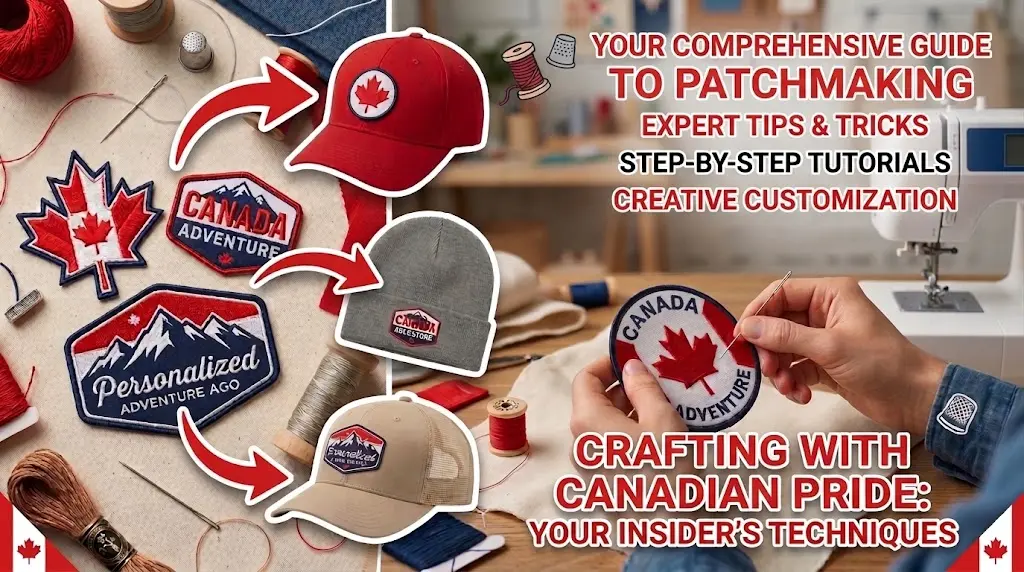
Walk through pretty much any farmers’ market, hockey rink lobby, or trade show booth in Canada these days and you’ll spot them: caps with patches instead of printed logos.
Not flat vinyl transfers, not basic embroidery, actual raised, textured badges stitched or pressed onto the front panel. There’s something about a patch that makes a five-dollar blank cap look like it belongs to a real brand.
If you run a small business out of Calgary, coach a beer-league team in Halifax, or just want one weird, one-of-a-kind hat for yourself, figuring out how to make custom hat patches is worth the twenty minutes it takes to read this.
This guide covers the whole thing in plain language, what patches actually are, how to make custom hat patches step by step, how to design them so they don’t look like a blob once they’re shrunk down.
What Exactly is a Hat Patch and a Cap Patch?
Before getting into how to make custom hat patches, it’s worth being clear on what we’re even talking about. A hat patch is a small emblem, usually somewhere between two and four inches across, that sits on the front of a cap.
Sometimes it’s sewn on, sometimes it’s ironed on with heat-activated glue and sometimes it’s Velcro, so it can be pulled off and swapped for a different one entirely. This is the major reason why so many Canadians end up ordering from The Custom Patches Canada.
Unlike a fully embroidered cap, where the design gets stitched straight into the hat fabric itself, a patch is its own little object, made somewhere else entirely and applied afterward.
A patch can be leather, PVC, chenille, woven thread, or embroidered twill, and none of that changes what kind of blank hat it eventually ends up on. That flexibility is a big part of why custom hat patches have taken off as an affordable way to brand merchandise across the country.
The Hat Patch Boom: What’s Behind It?
Teams and clubs have caught onto the same idea from a different angle. Patches are a low-commitment way to build identity. A scout troop or a family reunion doesn’t need five hundred units.
A Cheaper Way to Look Branded
Small businesses and side hustles have exploded over the past few years, and merch has become a cheap way to build a brand without sinking money into inventory.
Fully embroidered caps cost more to produce than a plain blank with a patch stitched on after the fact, so patches let a “small shop look” put-together, without the put-together price tag.
The Fashion and Community Angle
Then there’s the whole workwear-meets-fashion thing. Trucker caps, leather-patch snapbacks, that rugged outdoor look, it’s just what people wear now.
Which is exactly why custom cowboy hat patches and custom leather hat patches have grown in demand lately. Below shows the table about the different types of custom hat patches:
Types of Custom Hat Patches:
| Patch Type | Best For | Texture / Look | Typical Backing Options |
| Custom embroidered hat patches | Uniforms, everyday branded caps | Raised stitched thread | Iron-on, sew-on |
| Custom leather hat patches | Premium retail, outdoor and western brands | Debossed or laser-etched leather | Sew-on, adhesive |
| Custom PVC hat patches | Outdoor gear, tactical caps | Rubbery, 3D moulded | Velcro, sew-on |
| Custom velcro hat patches | Tactical, uniformed, swappable designs | Depends on base material | Hook-and-loop |
| Custom cowboy hat patches | Western-style hats, rodeo and ranch wear | Leather or embroidered | Sew-on, adhesive |
| Custom woven hat patches | Fine detail, small text, gradients | Flat, tightly woven thread | Iron-on, sew-on |
| Custom rubber hat patches | Weatherproof, high-wear gear | Similar to PVC, moulded finish | Velcro, sew-on |
The Demand Side: What’s Driving Custom Hat Patches Across Canada
Demand for custom hats patches Canada wide isn’t tied to one industry, which is part of what makes it interesting. Retail brands want them for merch drops. Cafés want them for staff caps.
Roofers and landscaping crews want tactical-style patches that can survive a full outdoor season without falling apart. Even wedding parties order small custom batches now, usually as groomsmen gifts.
What connects all of these buyers is scale or rather, the lack of it. Nobody in this crowd wants to order two thousand units just to get decent pricing. People want quality without committing their entire marketing budget upfront.
They want a smaller batch, made properly, delivered without a three-month wait. That’s really the whole story behind why terms like “custom hat patches no minimum” and “custom hat patches cheap” show up so often in Canadian search traffic.
How to Make Custom Hat Patches, Step by Step:
Here’s what the process looks like in practice, whether you’re doing this for a business, a team, or purely for yourself.
-
Start with the idea, not a finished file
A rough logo, a sketch on a napkin, even a description over email works fine to begin with. It actually shows the types of details you want to add on to it.
Most decent patch makers, The custom patches Canada included, will take that rough idea and turn it into something production-ready at no extra cost.
-
Pick the patch type early, because it shapes everything else
Embroidered patches give that classic raised-stitch texture people picture when they hear “patch.” PVC is rubbery and waterproof, built for stuff that lives outside.
Leather ages well and reads as premium. Custom woven patches hold fine detail and small text far better than embroidery can. Chenille brings that bold, fuzzy varsity look. Deciding this up front saves a lot of back-and-forth later on.
-
Choose a backing that matches how it’ll actually be used
Custom iron patches are easiest for a one-time home application. Sew-on is the most durable and is basically the standard for uniforms.
Velcro lets a patch come on and off, which matters a lot for tactical or uniform groups swapping designs regularly. Adhesive suits short-term giveaways, where longevity doesn’t matter.
-
Don’t skip the proof
A reputable shop sends a digital mockup showing the exact shape, size, colours, and backing before anything goes into production.
This step gets underrated constantly, it’s the difference between getting what you actually pictured in your head and getting a surprise in the mail three weeks later.
-
Then it’s production and shipping
Once you sign off on the proof, a professional operation typically finishes production within about five business days. Start to finish, the whole procedure execution.
The how-to-make-custom-hat-patches process usually wraps up in two to three weeks, even quicker sometimes for smaller runs.
Tips and Common Mistakes Worth Fixing
- Don’t shrink a detailed logo without simplifying it first, fine lines tend to disappear once a patch gets scaled down to actual hat size.
- Always check the digital proof against your real hat colour, not just a white background mockup on someone’s screen.
- Match the border to the shape: merrowed for simple outlines, laser-cut for anything intricate.
- Order a few extra, small reorders often cost more per unit than the original batch did.
- If a previous order had fraying issues, ask specifically about merrowed borders next time.
- Get turnaround time confirmed in writing before an event deadline, especially around
How to Design Hat and Cap Patches the Right Way?
Knowing how to make custom hat patches is only half the job. Design is where a patch either earns its spot on someone’s head or ends up in a drawer.
Simpler is Almost Always Better
Patches are small. Two to four inches doesn’t leave much room, and overly detailed designs, thin gradients, tiny text, delicate line work, tend to blur or vanish once they’re actually stitched or moulded down to size. Bold shapes and a limited colour palette translate a lot more reliably.
Design for the Material, Not the Screen
A design built for embroidery won’t necessarily hold up on leather or PVC. Fine text reads far better in woven design than in stitched design. Debossed detail looks beautiful on leather. Matching the design approach to the manufacturing method from the start, avoids a stack of revisions later.
Shape Isn’t Just a Circle or a Rectangle
Die-cut shapes that follow the outline of a logo, an animal silhouette, an initial, a badge outline, tend to catch the eye a lot more than a generic round patch sitting on a shelf of merchandise.
The Border Choice Matters More Than People Assume
A merrowed, embroidered border stops fraying and gives a clean raised edge. Laser-cut or hot-cut borders work better for irregular, detailed shapes where a stitched border would just compete visually with the design. Get this wrong and the patch’s lifespan shrinks noticeably.
Contrast Over Subtlety
Patches usually get read from a few feet away, not up close under a magnifying glass. Strong contrast between the background and the main design keeps a logo legible even when someone’s walking across a parking lot or standing at the far end of a field.
Where These Patches Actually Show Up?
Custom hat patches have far more use cases than you’d probably guess, in everyday Canadian life.
| Application | Common Patch Style Chosen |
| Trades and construction crews | Custom PVC or rubber hat patches |
| Cafés and restaurants | Custom embroidered or iron-on hat patches |
| Sports teams and leagues | Custom embroidered or chenille patches |
| Retail and apparel drops | Custom leather hat patches |
| Tactical and security teams | Custom tactical hat patches, Velcro backing |
| Scouts and youth organizations | Custom sewn hat patches |
| Weddings and personal gifts | Custom made hat patches, small batch |
Why Do People Keep Choosing The Custom Patches Canada?
Plenty of patch makers exist online. A few things tend to come up again and again when Canadians explain why they landed on The Custom Patches Canada specifically.
Low Minimum Order
The minimum order sits at just 10 pieces, which matters more than it might sound. We set minimums at 50 or 100 units, which shuts out small clubs and first-time buyers before they even get started. Ten is low enough that a local team or a solo entrepreneur can order exactly what they need.
Free Design Support
Design support is included, and it’s free. You don’t need a finished file. A rough logo or even a written description is enough to start, and nothing goes into production until you’ve approved a digital proof of the actual patch, colours, size, shape, all of it.
Fast Turnaround and Free Shipping
Turnaround is fast, usually around five business days once that proof gets the green light. That matters when there’s a season opener, a market date, or an event deadline breathing down your neck. Shipping is free anywhere in the country too, Vancouver Island to Newfoundland, without a surprise freight charge showing up at checkout.
Wide Range of Materials
The material range is wide, everything from custom iron-on hat patches to custom leather hat patches iron-on, sew-on chenille, and more, so the finished product actually matches how it’ll be used, not just how it looked in a mockup. This makes the different types of custom patches wholesale a realistic option for franchises and school boards too, not just small buyers.
Frequently Asked Questions
What’s the minimum order for custom hat patches?
The Custom Patches Canada, set it at just 10 pieces per design.
How long does it actually take to make custom hat patches?
Roughly five business days after the proof is approved, plus shipping.
Are custom iron-on hat patches actually durable?
They’re fine for everyday wear, though sew-on backing lasts noticeably longer under frequent washing.
Can you order custom hat patches with no minimum at all?
Not quite zero, but low-minimum options (as few as 10) exist for exactly this reason.
What’s the best backing for patches that need to be swapped?
Velcro is the best opinion and it’s built for exactly this reason.
Do leather hat patches cost more than embroidered ones?
Yes, since leather involves debossing or laser etching rather than stitching.
Is there a cheaper option for small businesses?
Iron-on and sew-on embroidered patches tend to be the most budget-friendly per unit.
Ready to Make Your Own Custom Hat Patches?
Learning how to make custom hat patches isn’t really about mastering some obscure craft. It comes down to four decisions: material, backing, border, and keeping the design simple enough to survive being shrunk.
Nail those, and the rest, proofing, production, delivery, tends to sort itself out. Whether you’re outfitting a hockey team, branding a small café, or just want one genuinely cool hat for yourself, working with a Canadian patch maker that offers low minimums, free proofs, and a fast turnaround cuts out most of the guesswork.
For anyone in Canada trying to turn an idea into something they can actually wear, The Custom Patches Canada is a reasonable place to start that conversation.